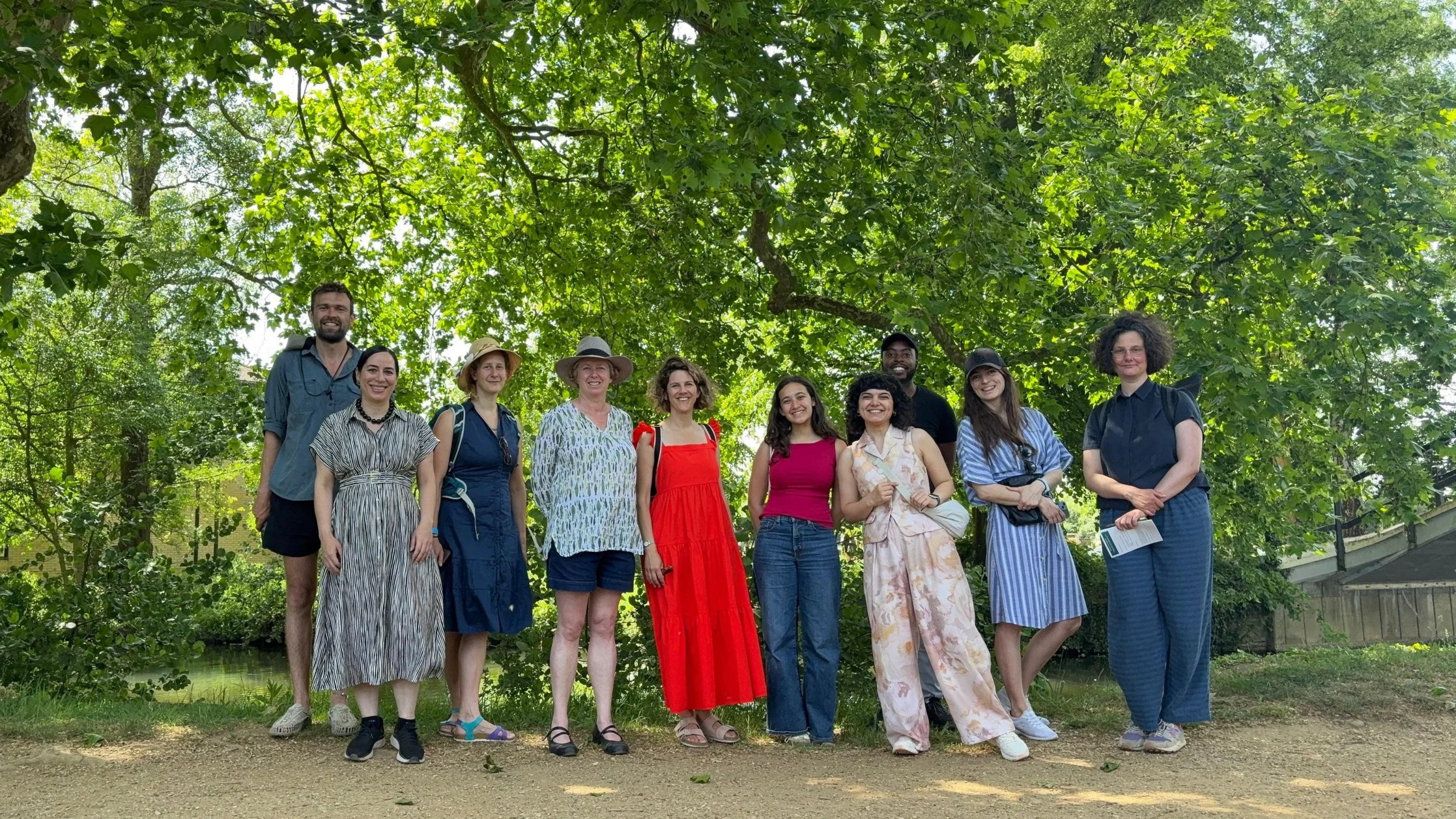
I recently spent a day at Brasenose College with researchers from Oxford's School of Geography and the Environment, as part of Be Like Water - a workshop exploring creative practice as a way of doing research.
We started with a water walk along the Cherwell, paying attention to things that might normally pass unnoticed. We collected river water, mapped the wetlands from memory and feeling, and looked at examples of early scientific illustration, when the boundaries between art and science were much less fixed.
But most importantly for me was when we embarked on an intuitive painting session.
We adapted one of the historic seminar rooms into a makeshift studio. Working in a Grade I listed building, with polished wood features all around, we had to make sure the paint stayed contained - otherwise we'd never be invited back! But at the same time, I wanted to create an environment where participants felt they could experiment freely and play.
We used the water we'd collected from the river, acrylic paint and sand to make paintings. No brushes, just palette knives and a handful of colours each. The point wasn't to make good paintings. It was to see what happened when we created intuitively, allowing our subconscious to influence our direction, based on our experience of the river earlier that day.
The question underlying all of this was: how can making become part of the process of thinking?
I've always been interested in how people learn, and in what happens when we give people permission to approach something differently. So it was particularly interesting to watch researchers - people accustomed to analysing, measuring and explaining - work through a process where there wasn't a correct answer.
A huge thank you to Claudia Neuschulz and the Water Appreciation Society for the invitation, and to the School of Geography and the Environment and Brasenose College for hosting us.
Curiosity and cross-disciplinary collaboration at its finest.